Xining, September 20th 2004
Departure on 16 September was late: The Toyota had to see the service again to complete the repair work. Through a wide and dry country we did our way on good roads to Korla, and find a good hotel with rather avarage food.
The next morning found the Toyota again with trouble: One blade spring was broken. Our guide Lee, in the meantime already a specialist for car repair shops, managed to have a new part fixed before lunch time and we could continue the travel southwards along the Tarim river. Hard to imagine Sven Hedin, shipping down this river a hundred years ago, with his boatsmen, cutting their way through the high reed. Today he would have been able to pick cotton at the shore right away from the boat,and he would not lose his way in one of the branches, but in the numerous irrigation canals. Our destination was camp 36, an oasis established at the end of the sixties just beside the ancient Miran at the southern part of the silk road.
Camp 36: To believe our guide, this was a well-known adress during the Cultural Revolution, when intellectuals and others were sent from their urban homes to the most remote hinterland to learn their lesson. It took the academics some sweat to create this farm inside the desert, but nowadays we found a well-working, but neglected & smoky internet bar, lacking any drinks – perhaps a hommage to the hard old times.
(GA)
18th early morning we left our hard chinese beds, only to see a dark-clouded sky, not very typical for the Taklamakan. We visited the city of Miran, founded 2000 years ago during the Han dynasty. By the way, it’s really true, the chinese are not able to speak a “r”, and therefore you will find this place as Milan in the recent maps...
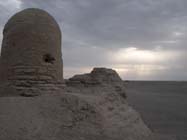
If one know about the descriptions of the european travellers some generations ago, the ruins are quite disillusioning. Nothing is left of painted stucco, coloured bricks or even murals. The meagre remains falling into dust, without any protection measures. The government is even on the way to contruct a road through the area… But still what is left is impressive: Pagodas, houses and a kind of fortress. All is made by sun-dried mudbricks and brushwood & straw in layers, with a clay and straw plaster. Trunks of big trees in the sand demonstrate, that Miran – nowadays covered by the sand of the desert – was at silk-trading times a city with well-watered gardens.
After the visit we started to the southeast to reach Huatougu at the western edge of the Qaidam basin. First the poor track led up a canyon with splendid fluviatile layers of gravels and sand towards a pass at 3600m altitude, than down again. But when climbing up to the high plain of the basin, at the same 50 meters, each cars lost one tire and we had to use our spare wheels. Now problems the next 30 minutes until reaching the edge of the plain, and we stopped for a photo of the surrounding of an asbestos mine, looking like the hell. PFFF, another tire of the Toyota gave up it’s air. Now the Nissan crew, with two tires on top, had to find a service station in that waste land – what they could not find, but a truck, who agreed to buckle up the 2600 kg of the Toyota and carry it the last 90 km down to Huatougu.
Lee found a place to repair the tubeless (no more tubeless to China!!) tires, and after 10 hours for 270 km the day was finished with an unexpected good hotel and even excellent food at 11.00 pm.
(TC)
19 September, a Sunday, the day of the Qaidam basin! We knew before, that 600 km of bad roads were ahead, and we started 07.30 am, for this region in th middle of the night. We were recommended the northern route, longer, but less gravel than the southern one. Immediately after departure the road repair sites started: Down from the asphalt into the dust track, which could be managed only with 4x4 and below 20 km/h. After seven hours only 220 km were done, at the second part of the journey through a magnificent landscape of vaulted rock formations. Than we entered the “good road”, completely made of salt: To construct this unique lane, take salt with a small amount of clay, roll it to level, sprinkle it with water and wait until dry – it will be like concrete, if you are in the extreme dryness of the Qaidam. Two hours more through absolute dead salt desert, and we arrived at another repair site: No car was permitted to enter the road, before the surface had been dried up. Beside us, there was only one truck, who seemed to know a detour, and we followed him into a bizarre scenery. Shortly later there was only the track of the truck, but we found a more distinct trail. One hour to the south, the track disappeared, and a huge salt lake (Xi Taijnar Hu) appeared: We had done it into the deadly heart of the Qaidam! Surprisingly, an enormous plant in construction was to see near the shore, with hundreds of workers around - a canal from the lake had been already dug towards the site. An ingeneer helped us to find the way to Golmud, but refused to give us an explanation to the plant (our speculations were waving between an atomic laboratory or the production of the chinese ultimative weapons)!
Following was a dreamland travel: Diagonal across the basin we passed through phantastic landscapes, sometimes moon-like, sometimes reminding us to former trips to Mars and Jupiter. The very good road was neither a public one nor marked in a touristic map. At 10.00 pm, after 14,5 hours of uninterrupted driving, we reached Golmud. Nice hotel and late hot food.
(G&BA)
The typical chinese breakfast, including rice soup, cold noodles, porc knuckles and fermented vegetables, in our bellies, we left for the 780 km drive to Xining. For once, as promised, the road was in a perfect condition. A pleisure for our desert tortured eyes was the return of some vegetation after 200 km east of Golmud. We passed an oasis situated at the Qaidam River, with nice aranged weat-, barley- and rapefields. The crops have been arranged in rows of sheafs to dry on the fields. From 2600 m we climbed up to 3817 m through tibetian pasture grounds with Yaks and flanked by mountain ridges up to 6000 m altitude. On the road: a single biker from Stuttgart on tour from Lhasa to Bangkok.
From our up to now highest point we descended to Lake Qinghai on 3200 m. Scattered along the lake, hundreds of praying ribbons were fluttering in the wind. Without knocking over one of the sheep with suicidal tendncies we reached the valley of the Huang Shui River. Descending down the valley on the Express Highway with the first tunnels since Germany, we arrived at 8.00 pm in Xining on 2300 m, after 27 days and 13700 km of travelling. With little help of our guide-book maps we easy found the hotel, in which a congress with tibetian women took place (girls not comparable with the contest beauties in Kazachstan!).
(TC)