Almaty, September 11th 2004
After 9800 km we finally arrived in Almaty, the first step of or travel to China. Both cars are already a bit down, we should mainly blame the Nissan company to construct a 4x4 which could be used only “on road”. We are sitting in good, old fashioned comfort in the hotel Arman and will rest here a day, befor starting our round trip in China. But first we should report our Altaj adventures!
We left the sanatorium in Öskemen on September 5 around noon and drove towards the east into the Altaj, guided by Mischa from ECOSYSTEMS. Quickly the mountains become high with autumn-coloured forests at the slopes and valleys. We had to cross the huge reservoir of the Jertis by a ferry: A small aged (revolutionery?) steamer attached to a big flat tin, which carried cars an folks. Two hours and a broken tire later we arrived in Majmyr, a small farm at a southern foothill of the Naryn valley. This was our base for two days.
For sleeping we chose an old wagon and a yurt, both nicely equipped, only the beds were of a rocky combination of iron strings, wooden boards and an irregular thin fabric top, which together worked like an alarm clock: Every hour you woke up during night and had to arrange your bones again. A sauna with cold showers was included, and after that and a fine dinner we paid our respect to the Russian traditions and cleared one and a half liters of local wodka, together with a couple of beers against the thirst. Clemens and Moritz did their best to show German skills and continued until 06 in the morning.
(TC)
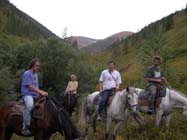
The next morning was just for Barbara and me: Our landlady Tatjana walked with us to a pretty waterfall, but what she told us on the way about officinal herbs, was academic standard. Not to believe, which traditions are still alive in the Altaj, that would be worth a special journey! Early afternoon the rest of the crew started to show up and a ride on horse back was decided – without Barbara, who argued to have her “horse years” already passed, but with Tatjana as a experienced guide. My horse didn’t like my extra-weight and after an hour uphill, Clemens and I turned back to the farm, where w arrived at around 18.30, while the others continued towards the snowy peaks. And the big waiting began, night started and anxiety came. A neighbour was sent into the night with his horse to look for the missing, but came back at 22.00 unsucessful. I started with the car along the foothill on a possible return route of the riders,without finding them, but when I returned at around 23.00, although the horses were not there, Moriz and Ueli stayed in the farm, bloody and everywhere scratched on legs and arms.
(GA)
What happened: Ueli and I wanted to have an outlook from one of the mountain tops and Tatjana agreed and guided the group up a slope. The view was really magnificent, glaciers an snowy peaks over red-coloured valleys all around! But the way down seemed not to be very comfortable, and e had to take the horses on the bridlesdownhill. After 45 minutes walk through bushes and shrubs we had lost any path, darkness came and the slope was dangerously declining. Just before complete night we were trapped on a high cliff, but could see a track dow in a valley. No chance for the horses to move on! Tatjana was too stressed for any decision. To make a move, Ueli and I slided down a rubble declivity in the night to look for help, leaving her with the horses at the windy spot. The darkness let us feel, not see, that the slope was scattered with roses, but we managed to find the farm after an hour blind flying, totally exhausted and fortunately not ripped by the snow leopard. Again the Kazakh neighbour with the horse, by the way a ranger, was sent out to rescue Tatjana and the horses, what he did, now knowing the place and a better way, in less than an hour. Impressive to see a man with a horse working in the night, knowing nature and only communicating by whistling, and not using “modern” technics. Happy end! And Tatjana, a little bit rumpled, even prepared a good meal.
(MA)
After a great breakfast we made the cars ready for the road. Once more we had to pay a permission to enter the “Natonal Park”, had to hire another guide who imediately fell asleep when the car started to move. But, honestly, he woke up just before every bifurcation and told us where to go. We drove up the valley along the northern foothills, enjoying the beautiful coloured wooded slopes – it was a perfect sunny early-autumn day. The white waters beside showed marvelous “braided patterns” (for geographers!) in the valley ground, flanked by impressive granite formations.
(UM)
After an hour we arrived at a wide plain above the river bed south of the village Berel with dozens of Sakian burial mounds, 2500 years old and at present excavated by archaeologists from Almaty.The special thing with these Kurgans, beside a perfect conservation of the deep-frozen bones and offerings, is their construction. Clay and debris were put in layers in such a way on top and around the wooden burial chamber, that an artifically a kind of permafrost was created. Permafrost is not existent in that area, at 1400 m altitude, since the ice age. Unfortunately, communication with the “archaeologists” was basic and only possible with the help of Mischa as translator, the head of the team was far away in the capital…
(GA)
After visiting the graveyard we had to cross the river on our way to Markaköl by an iron suspension bridge of some age. Mischa and the other guide were, for the dimensions and the weights of our vehicles, quite afraid to do so, but the cars were not. With Mischa alone we continued our way uphill an old track, constructed after World War II by Austrian prisoners, the “Austran track”. Magnificent alpine surounding, but a terrible road, interrupted by waters and muds. It took us three and a half hours to do the 60 km! But arriving at the Markaköl lake, we fond a absolutly not attractive village and ECOSYSTEMS’ base camp near the swampy shore, covered with bulls’ (and cows’) shit and empty wodka bottles. Also the camp had few things to do with the one described by mail, we had the choice between an out-at-elbows brick house with an ugly “kitchen” or a plastic covered yurt, squeezed in two huts. In one of the shabby rooms a picture of a tourist, a client of the company, having just hunted a Maral (a nearly extinct and therefore protected big deer) was hanging from the wall, not far from the label of WWF. Is the ECO in Ecosystem related to ecology or, which seems more probable, to economy? We absolutely did not like the camp place, perhaps attractive for hunters of protected species, and decided immediately to leave the next morning. Okay, there was a good sauna in the evening and we prepared on that grandfather of a stove in the kitchen corner very tasty kidney beans with russian bacon & garlic. The boys slept under the veranda of the local museum (as Mischa described the building), and Barbara and me in passable beds in the house.
The same wa back killed some parts of our cars: The end part of the exhaust of the Toyota did not like to continue the trip and tried to hide in the ditch, the reling at the roof of the Nissan also started to be not longer a part of the car: It was only fixed with tiny screws to the sheet metal of the roof.
Tatjana liked very much, that we appeared again, good food and a cold night with an enormous starry sky: In the morning there was the first ice on our washing water. On 09 September we took the bumpy northern road back to Öskemen, the boys only to find the ladies of the beauty contest no longe staying in the sanatorium. We could repair most of our breaks for nearly no money. Dinner was again in a fast food, not bad at all, Mischa could not be persuaded to show us a Kazakh restaurant.
In the morning the Nissan showed a snout declining down to the front axle, something wrong with the suspension system. This probably can only be repaired in China. But after 8 hours drive we arrived in Lepsinsk, a beautiful and historical place before the snowy Zongar Alatau mountain scenery, welcomed by a Tartar family. An extremely clean and proper Muslim household, beds to dream in, great food and Flora, the friendly housewife, her husband Richat as a competent guide to the kurgans of the area and 82-years old grandfather Ahmet, who discussed with us (in German!) about the misery and nonsense of war and his time in the defeated Germany. Gerd, for the first time, could use his Turkish, the Tartar language seems to be more related to Turkish than the Kazakh one. A shadow was only the corruption of the local administraion, which asked 40 Euro (as a “tip”) for our registration: We had already paid 10 Euro each for the permission to enter this border region closed to China. But this Lepsinsk, where “milk and honey is floating”, as the German zoologist Alfred Brehm descibed it in the 19th century, is to recommend as a tourist place. We saw a stele of Tamerlan with his border signs (probably a “milestone”) and the tombstone of a bearded Turkish man with a cup (for wine?) in his hand and a sword at his belt. Beside that, Lepsinsk is the place, where the evil Tungans were defeated by the Kazakhs, who, at the same place, signed a dozens years later a treaty, to give the country under Russian rule- but this was in the 19th century, the Russians have nearly all gone and the Tartars live in freedom and good relationship with their Kazakh fellow believers.
Today, on the way to Almaty, we had another excavation of the old Turkish capital Kayalyk, 8th to the 14th century. The candidate Boris Zheleznyakov from Almaty University gave us general information about the archaeology in the country.
Last information on 12 September: Eva Schumm arrived last night with some chocolate and in good health at Almaty airport. Now the crew is complete!