Khotan, October 11th 2004
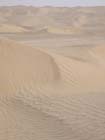
October 9th: Dust and sand is in the air, and a strong wind is coming from the east, not excellent conditions to cross the Taklamakan from North to South. To approach the desert we first had to drive through the band of vegetation along the Tarim river, which is nearly 140 km wide. Impressive are woods of poplars with two kinds of leafs at the same branch, the fresh ones willow-shaped and the older ones poplar-like. 40 km after the Tarim the sandy desert appears: 430 km with nothing but sand dunes in uninterupted waves. The Chinese are doing a great job: To avoid sand drifts on the track they installed an irrigation system (drop tubes) along all the way and planted a stripe of 60 m east and 30 m west of the road. The work is nearly complete!
In the midst of the desert, suddenly derricks and fields of oil-pumps emerged and the dunes are criss-crossed with traces of huge prospection vehicles – big business!
Shortly after this new-age Fata Morgana suddenly some big trees on self-constructed “humide-mound-biotopes” were to see. The wind became stronger and stronger and at the end of our trip we had something like sandstorm-feeling. We arrived in Minfeng and there is nothing to say about this dusty town; only that the sand will cover it slowly from the north – not a big loss…
On 10 October we followed the southern route of the Silk Road via Keriya (Yutian) towards Khotan (Hotian). At least in Keriya you are in Eastern Turkestan. Chinese are rare,and life is central-asian: Bread and kebabs all along the streets, wild looking long-bearded fellows with high black Atatürk – fur caps are driving small donkey carts with loads of anything over the streets. It’s Sunday and we are lucky to arrive in Khotan in time to visit the Sunday market. Perhaps a thousand stalls and ten to twenty thousand visitors: An atmosphere like in Afghanistan 30 years ago, only more noicy, excited, busy and with quite a number of unveiled women.
Already yesterday we looked for the famous white jade in the riverbed of the Yurungkax – without success. Today we were more lucky, when we visited the ruins of the ancient capital of Khotan, Malikurwatur, situated 20 km south of the nowadays centre on a river terrace. We found, besides other stone beauties, four pieces of jade in the gravels, only a bit wind-and-sand-polished.
After a 700-years old walnut tree – which is said to be the first one in Turkestan – we found a Chinese investment in Khotan, a silk factory. What impressive insights in the early industrialisation! Huge halls without any climatisation, noise protection or odour filters! Hundreds of young women – no chance to become old in this job – are working here without earflaps (otherwise they would not be able to hear any dissonance of not well-working machines, as one from the management point it out) in the infernal noise of a hundred automatic looms or in the stink of decaying silk worms when reeling off the silk threads, hands all 8-hours-shift in warm water: All this for 100 to 200 Euro piece wages a month. We took the favourable offers in the factory’s shop and bought some silk scarfs for home…
The end of the day saw me on the hunt for the famous old Khotan rugs, first in the bazar, then in village houses of the oasis. Results: The carpets of the last hundred years, which still can be found in Khotan, are of poor quality, concerning fineness, colour and wool – the last could be due to the extremely arid climate. I never saw so many worn down and bleached rugs on a heap! I was told, that during the last years merchants from Pakistan are buying old carpets (to embellish the pieces in Islamabad? Take care of ink-coloured specimen!). Prices are low – a Khotan carpet which is on sale in Bale for 30.000 SF was probably bought here a few years ago for 300 $.
(GA)