Kuqa, October 8th 2004
Like the last days the 5 October had nothing to offer but desert, mountains and oasis, but we won´t complain: the roads were good.
After 200 km we left the mainroad and turned right onto a dusty track to look for a neolithic village. All we had was a foto of the area where the village was situated and so we tried to compare the foto with the landscape – we didn´t succeed and had to leave without microlithic tools we were hoping to find.
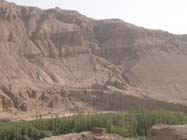
After another easy 200 km we learned that we had still plenty of time and decided to do some of tomorrows’ program. So we visited the Beziklik Caves in the “Flaming Mountains”. These buddha caves date back to between the sixth and the fifteenth century.They were looted by german and other scientists and ravaged by muslim hords and the chinese culture revolution, so only little parts of the beautiful frescoes remained untouched. Some of the buddhas and frescoes today can be seen in the Museum in Berlin-Dahlem. But still, the overwhelming site of the caves was worth the trip: situated at the bottom of a valley with a river winding its way through, the caves are surrounded by red glowing mountains. All in one a picturesque surrounding for a buddhist worshipping place.
Our next stop, already situated in the Turfan Depression, was the ancient Gaochang (Karakhoja), a city founded in the first century BC. It first had a military function and later became prefecture of the new region of Gaochang. Until the thirteenth century the city changed several times between prefecture and capital of different empires and was finally burnt down in a war. Today one can walk nearly free in the ruins inside the 1.5 x 1.5 km measuring citywalls. The ruins are mainly soil mounds, because the sundried mudbricks didn´t stand the errosion and the Red Gards of the Cultural Revolution turned parts of the city into fields. The most important building of Gaochang was the buddhist temple which remained in the best condition of all the buildings. From the temple back to the maingate we enyoied a ride on a dolly pulled by a donkey. Only 40 km more to Turfan and we enjoyed a good Uigur dinner.
The next morning we continued our „ruinhopping“ at the ancient city of Jiaohe (Yarkhoto), which means confluence of two rivers. The city is situated on a high plateau which was generated by two rivers and offered good protection against military attacks. Most of the buildings were dug in the ground what made them cool and for nowadays visitors today better to recognize. Sediment layers can be studied on the buildings´ walls. One for China unique stupa was situated in the centre of a stupa field, counting 101 specimen.
Originally a Hun-city, Jiaohe was conquered by the chinese after a long siege. The city went through its glorious days during the Tang-Dynasty in the sixth an seventh century. The devastating hords of Dschingis Kahn also gave Jiaohe a visit and destroyed the city.
Nowadays Jiaohe is part of the UNESCO world cultural heritage, which offers better possibilities to protect the ruins.
Then we turned the wheel of time forward and landed near the 1777 built Sugong tower, also known as the Emin minaret. Its height is 37 m and it was constructed out of clay bricks which were aranged in different patterns. The mosque with its minaret was situated in the eastern part of Turfan in a huge vineyard. We took the chance to visit a private vineyard with a drying loft and got a good impression of the grape production: after harvesting the grapes they are sulphurized above a clay stove and hung in the drying room, constructed with penetrated walls for an easy access of the desert winds..
After lunch we went to the busy bazar which was once more a good example how different China can be. With its oriental touch it showed the daily presence of the Uigur culture in the autonome province of Xinjiang.
For dinner young and old went it’s own ways. We all met again later for some bottles of the local vines – so, so – before everyone went to bed.
Our ride on 7 October was the distance between Turfan and Kuqa, or from the Gobi to the Takklamakan desert (from stone to sand). On the way we stopped in Korla to pick up our camping equipement we had left there three weeks ago. No road dolls, just road tolls.
(TC)
Unfortunately Kuqa has a cloudy sky in the morning, we were told about a rainy depression in the north near Urumqi. Again buddhist grottos! On the way to the north-west b taxi – we wanted to be easy on our cars and drivers – we passed bizarre rock formations of red and green sandstone. First the Kizil caves, also heavily demaged, but sure better preserved than Beziklik. Bad: To see the best preserved frescos in cave 38, an extra fee of 10 € pp has to be paid! Colours here are fresh, persian and indian influences can easily be recognized.
Next were the Kezir grottos: Absolutely no other tourist and therefore a visit with pleasure! But first the taxis had to plough through heavy dust (our decision not to take the Nissan & Toyota was correct!). Many detailed scenes with animals, kings and nobles dressed in persian-european style. In one cave a band of 16 girls were shown with different music instruments, including a harp, lute, a shawm and other flutes.
Before we returned to the town, we had a photo stop at the best conserved signal tower of the Han Dynasty, even the wooden bars survived.
(BA,GA)